Your ad clicks are landing on slow pages. Your first-time visitors are bouncing. And your Core Web Vitals dashboard isn't showing you any of this - let's dive into the world beyond the 75th percentile. And not make it a snoozefest.
The bold: talking about math
I have a confession: I'm terrible at statistics. You know that famous puzzle with 3 doors and a car? Yeah, completely goes over my head.
So here's the irony: I need to explain percentiles to you. Because understanding P50, P75, P90... it actually matters when you're optimizing web performance. Those numbers represent real people.
Then recently I saw Sergey (senior engineer at Cloudflare) his presentation: 7 levels of performance journey. This made it visually click for me.
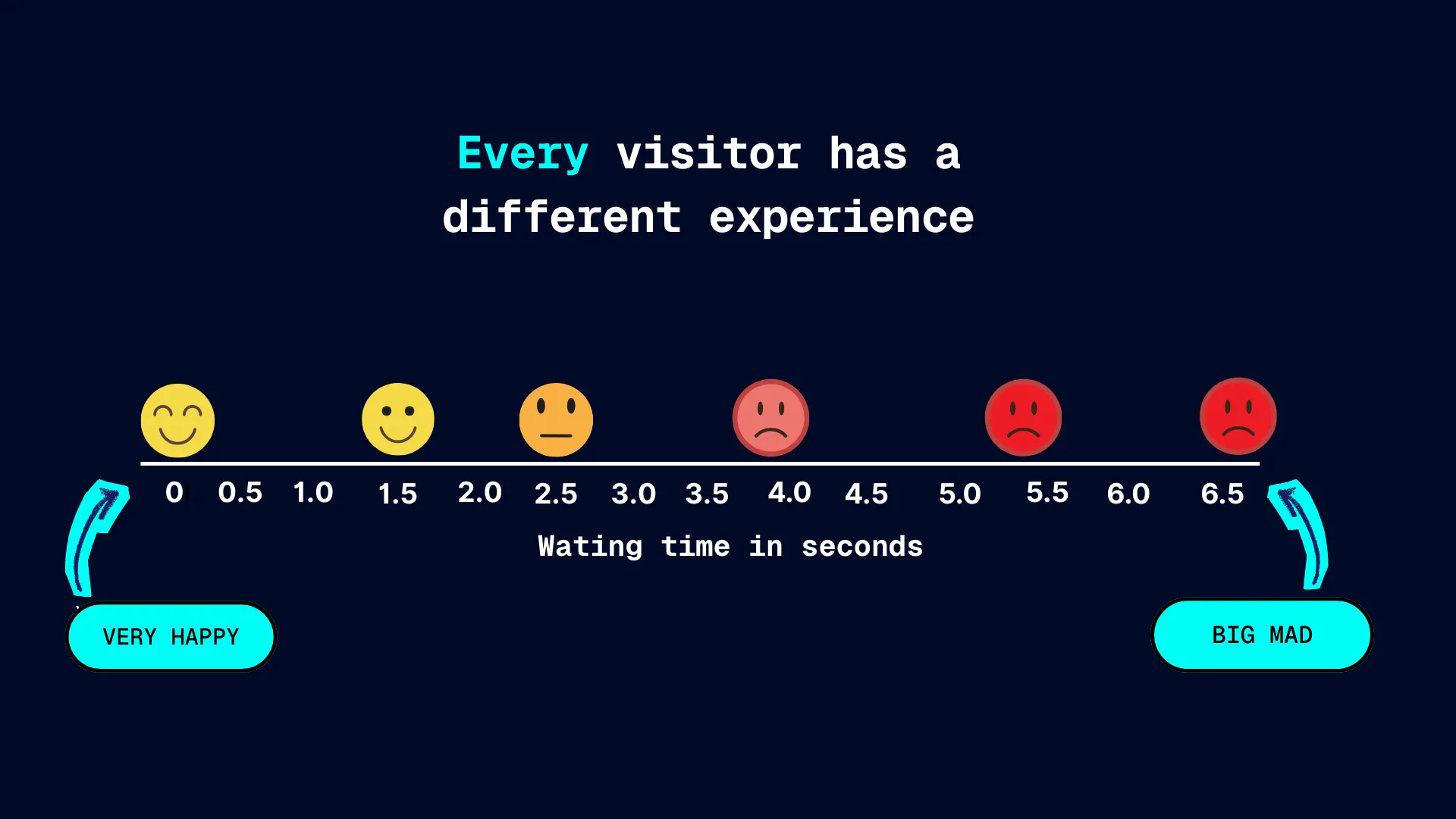
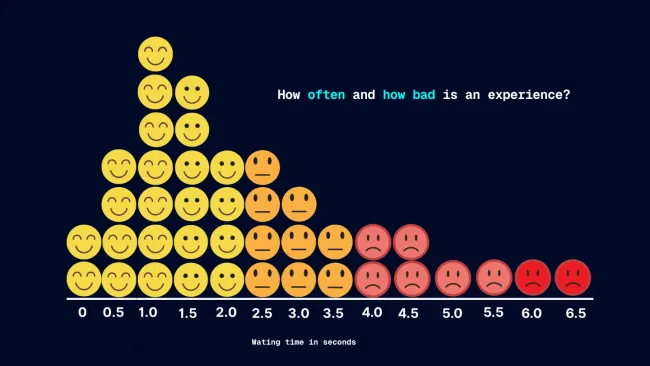
That's it. Not numbers. People. Some happy, some waiting, some frustrated.
So, let's go on a journey - which I jokingly called in percentiles for noobs- and understand percentiles and why they matter. You will probably come to the same conclusion as us - we really should look beyond Core Web Vitals here. And aim for the P90 club.
What P75 actually means
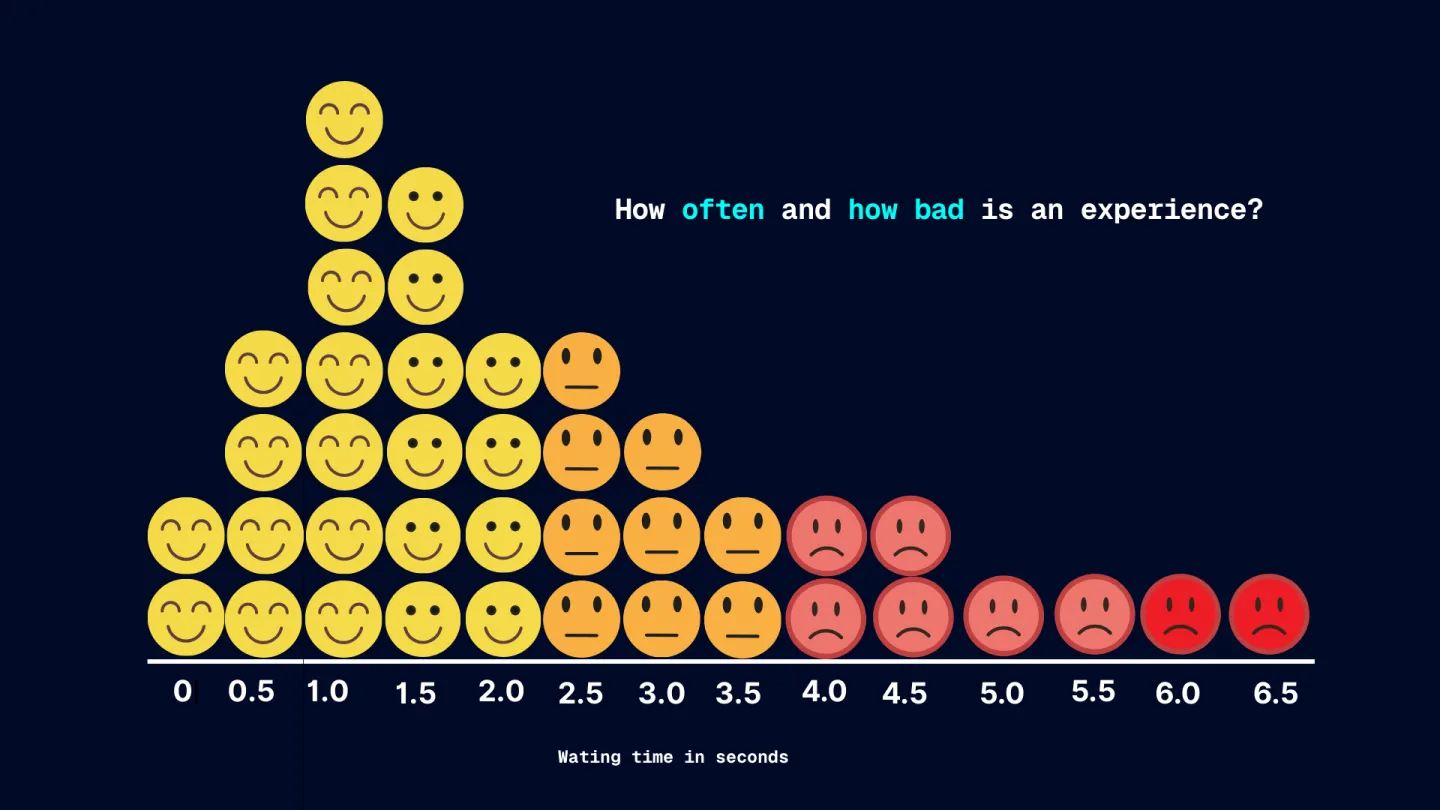
In short, looking at the 75th percentile basically means: is 1 in 4 people frustrated?
When you look at your Core Web Vitals dashboard and see that nice green checkmark at P75, here's what that actually means: 75% of your visitors had an experience equal to or better than what you're seeing in the report. Which also means 1 in 4 had a worse experience.
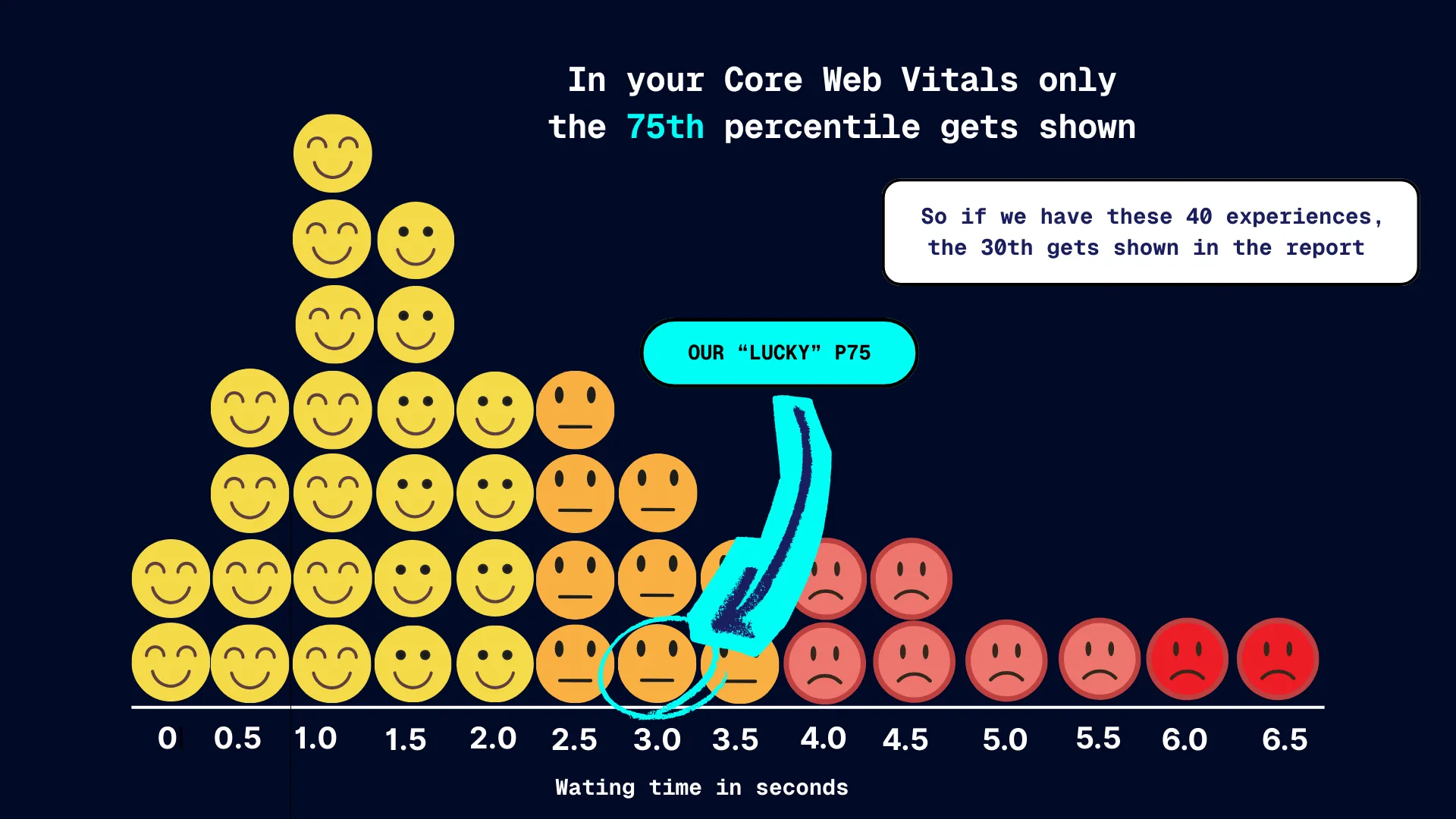
And you have no idea how much worse.
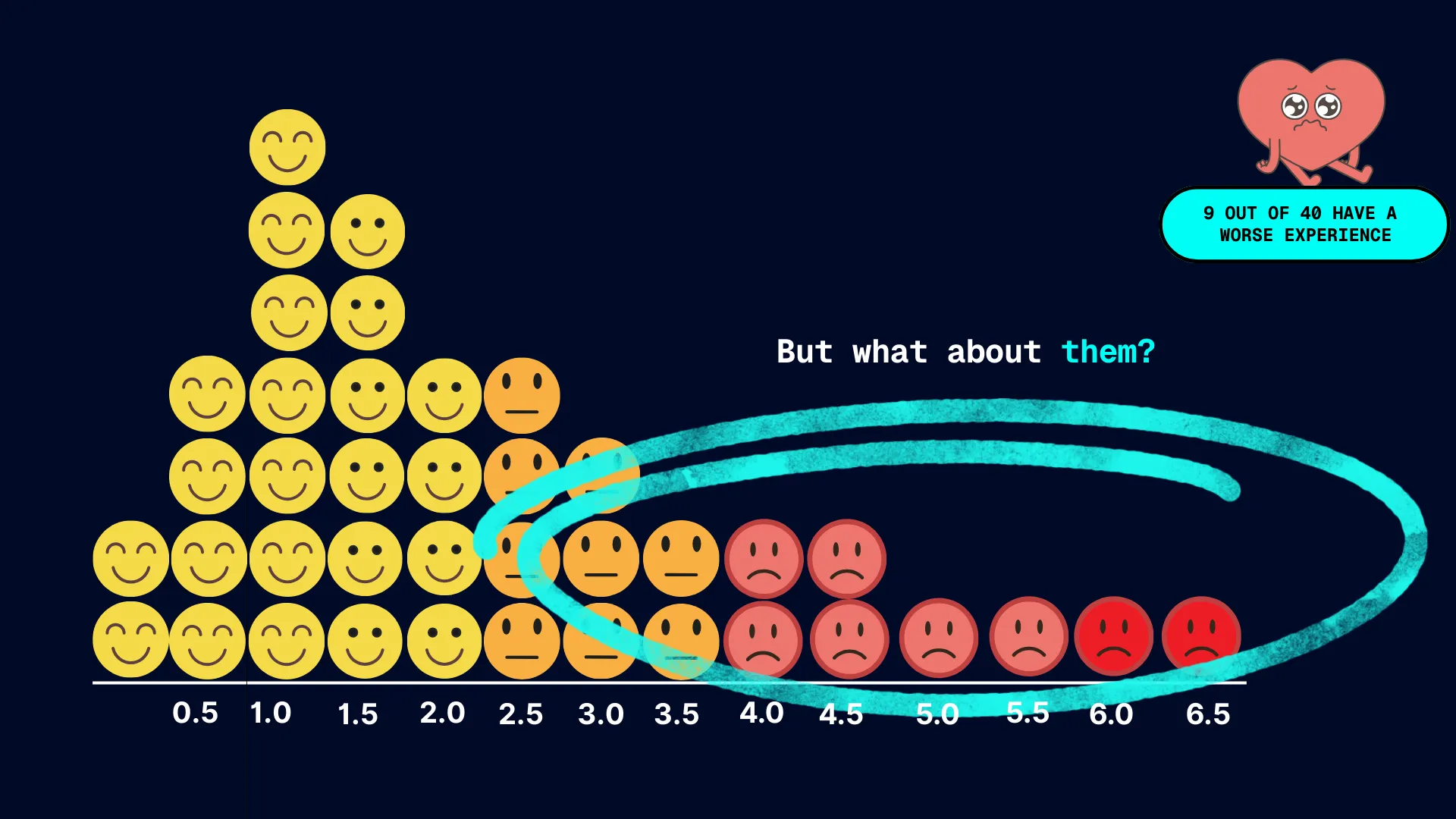
Your P75 might look great. But that remaining quarter? They could be waiting forever. They probably experience a lot of isssues. But you're just not seeing them.
These aren't just statistics
So far, we've been talking small numbers and statistics. But let's shift the conversation to what matters: real customers.
One of the key things we talk about in web performance- and real user monitoring in particular - is that you are observing a site in production. With thousands, if not millions of daily visitors. Every person who visits your site has a different experience. Some have high-fiber internet on desktop, some are on 4G on a train. Some have everything cached, some are loading for the first time on a slow connection. Just like real life, the data is messy. Or at least, complicated.
The thing with websites, and e-commerce especially, is that you can't control who uses your site and in which conditions. You can run your code in a silo and synthetically test it, but you're going to miss a lot of real experiences that way. Network conditions, device capabilities, browser versions, background processes, third-party scripts - all outside your control. This creates a wide, unpredictable distribution of performance data.
P75 captures central trends but leaves too much on the table. And often the most valuable part.
Your business goal is clear: these visitors wanted something from your site. Make sure they stay, don't bounce, and ideally convert.
Achieving that goal is where looking at the 90th percentile comes in.
The customers between P75 and P90: often first time visitors
Here is an extra fun fact about the visitors that you're not seeing when just looking at Core Web Vitals: they're often your most valuable potential customers. People who clicked through from an ad you paid for. First-time visitors with nothing cached. Users on mid-range phones. People who might have converted, but your slow first impression made them bounce.
Would you accept that in any other part of your business? "We're okay with 1 in 4 customers having a bad experience in our store"? Or "1 in 4 of the hamburgers we serve is causing foodpoisoning"
Of course not. But that's what focusing only on P75 means.
Why Google chose P75 (and why that's not enough for your store)
Google chose P75 for good reasons. It ensures a majority of experiences are good and prevents the metric from being skewed by extreme outliers. It's easy to understand. That's fine for a global standard that needs to work for every website, on every device on the planet.
But for your e-commerce business? You should care about more than just "a majority." Especially when that majority leaves out the exact customers you're paying to acquire - with ads, SEO, influencers, AI..
Good experience for 9 out of 10?
Enter P90! When you optimize for the 90th percentile, you're ensuring 9 out of 10 users get a good experience. You're only accepting that the bottom tenth might struggle and honestly that's often genuinely difficult scenarios like very poor connectivity or ancient devices.
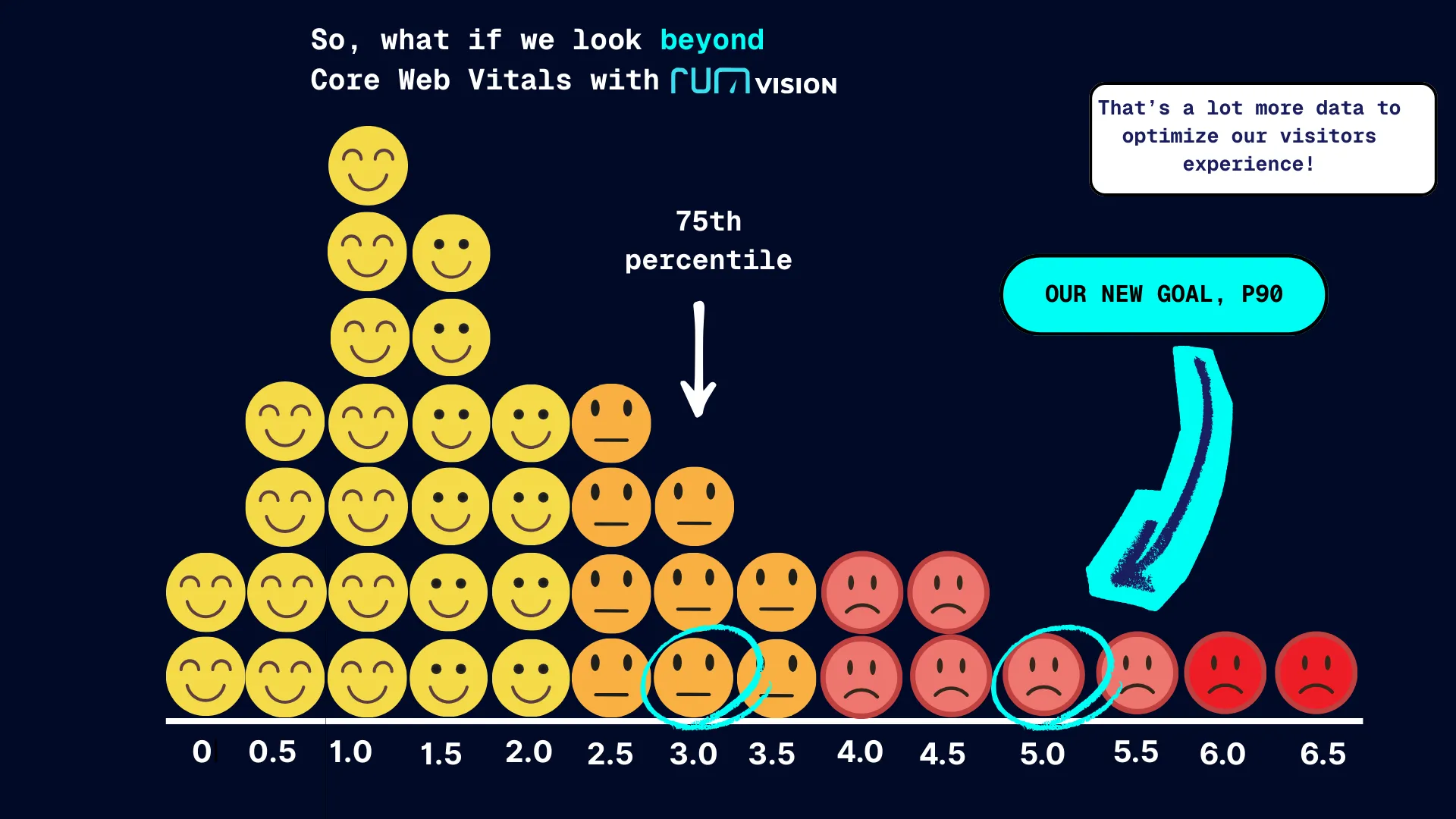
P90 captures the wide range of user experiences you encounter in e-commerce without getting lost in the noise.
You might ask: why not P95? Or P100?
Why not optimize for everyone? Here's the thing: you've got to know when to stop. Real world conditions mean there's always going to be edge cases - someone walking into an elevator and losing connection, a phone crash, genuine network failures you cannot control.
P90 is the sweet spot. Ambitious enough to dramatically improve on P75, realistic enough to actually achieve. That's a goal that moves the needle without requiring you to turn your site into a plain HTML page.

The beautiful: everyone benefits
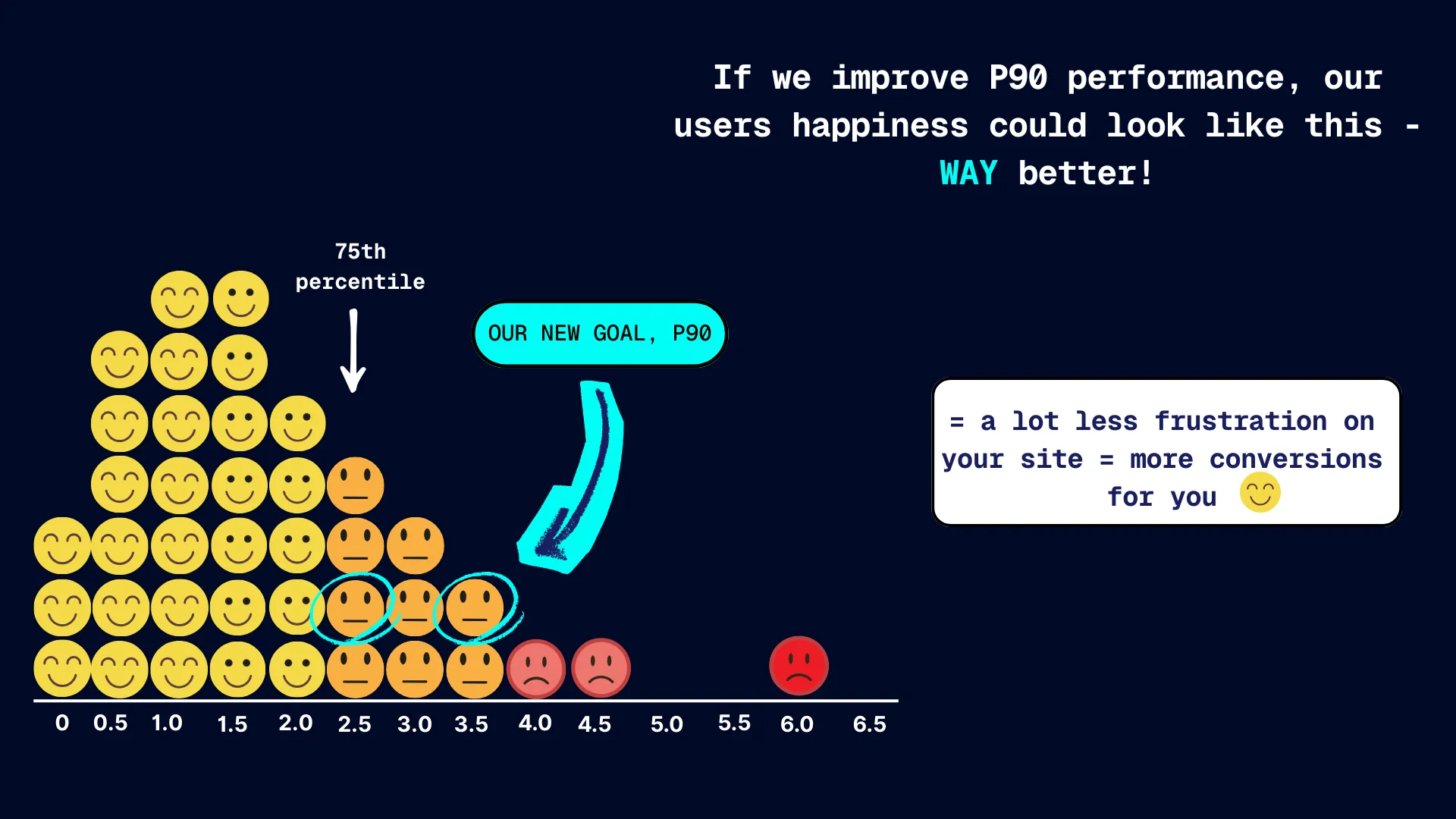
Here's what makes optimizing for P90 so powerful: you're not just helping those users between P75 and P90. You're improving the experience for everyone.
When you make changes that bring your P90 down, the whole curve shifts. More people move into that happy bucket. Your P75 gets better. Your median gets better. Everyone benefits.
You're essentially raising the floor for your entire user base. The improvements cascade down.
Happy visitors = more revenue
There's a business case to be made it. For that, we have to talk numbers. Studies show significant correlation between performance and revenue:
- Vodafone saw 8% more sales from improving their LCP
- Ray-Ban doubled their conversion rates with performance optimizations
- redBus reduced their interaction delays by 250ms and saw a 7% sales increase
- Swappie increased mobile revenue by 42%
Now, are these perfect case studies? No. Correlation vs causation, lots of variables, you know the drill. Performance improvements rarely happen in isolation.
But here's what we DO know: Your slower users aren't seeing small delays. They're seeing multi-second delays. They're in the frustration zone. And people don't buy from sites that frustrate them. And likely won't return in the future.
And remember who these users are: ad traffic, first-time visitors, people on mid-range devices. These are exactly the people you need to convert. You're paying to get them there. Don't waste that ad spend with a slow experience.
More happy people = more conversions = more revenue. And if your competitors are optimizing for P75 while you optimize for P90, you're delivering a better experience to more of your shared audience. That's capturing sales they're losing.
Making the shift in practice
If you're hitting P75 now, here's what moving to P90 means:
- You're aiming for faster experiences across the board. Sub-second load times. Instant interactions. No layout shifts.
- More ambitious? Yes. But the web has changed since 2020. Faster devices, better networks, modern browsers with built-in optimizations.
We're already seeing properly optimized pages hit really fast load times. This is absolutely achievable now.
How to actually do this
Get a RUM tool that shows you P90. Core Web Vitals only shows P75. Then look for big gaps between your P75 and P90. That gap represents real people having significantly worse experiences. Find out which pages are worst, which devices struggle most, what's loading slowly for these users. Then fix the biggest problems first. Every improvement helps real people.
That's where real user monitoring like RUMvision comes in to give you insights:
- Which pages have the biggest P75 to P90 gap?
- Did those speculation rules actually work?
- Why did BFCache fail and how often did it succeed?
- Is your LCP accidentally lazy-loaded (account for different LCPs per device and cookie pop-ups)?
- Are your ads causing cache-misses?
- What element is causing CLS and on what template?
- Are your scores green on all browsers, at the 90th percentile?
Core Web Vitals won't give you that info. Most RUMs won't either. But with RUMvision, you'll have data on how fast everyone is on your site within minutes of installing a snippet.
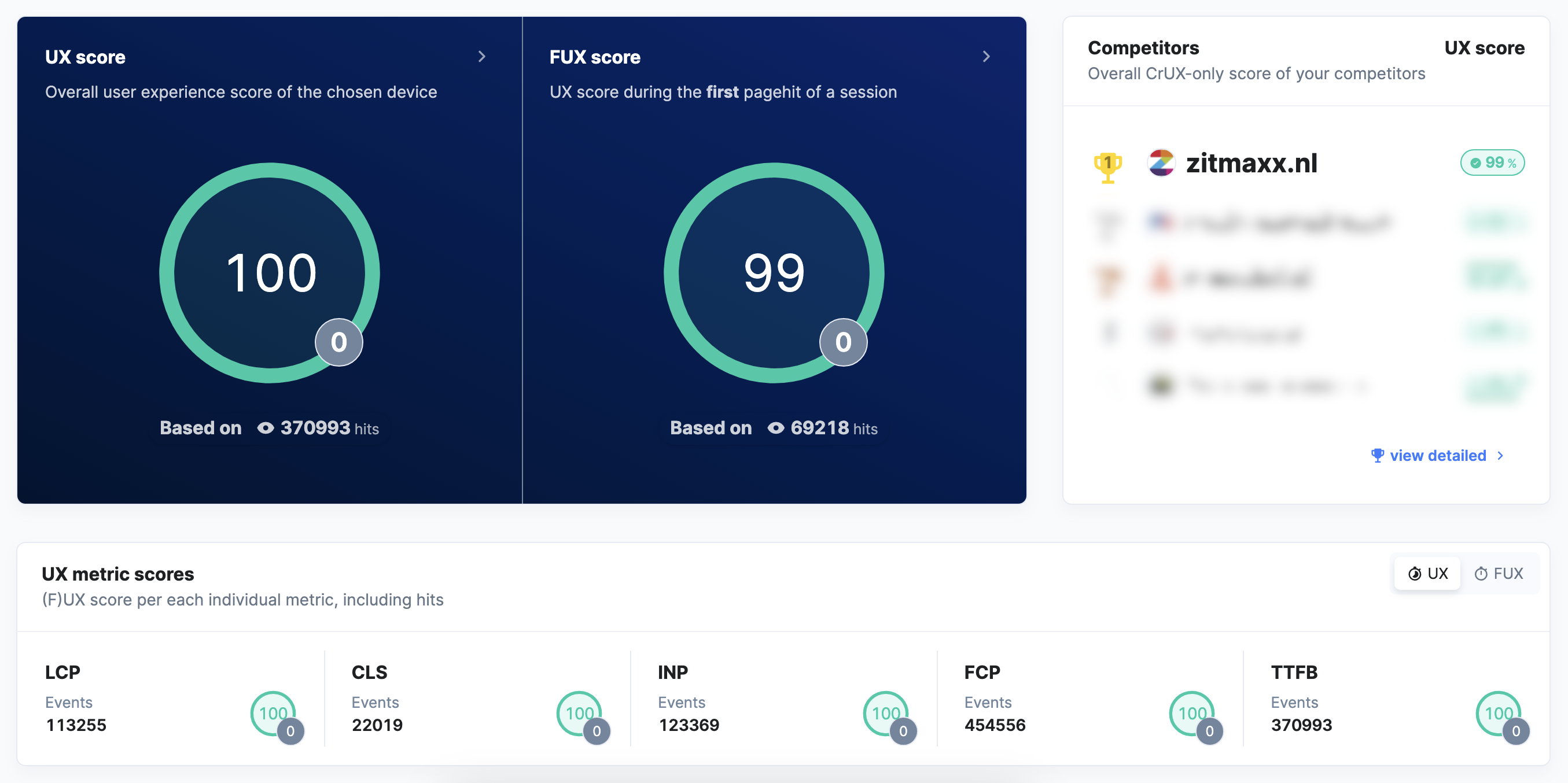
90th percentile successtory of zitmaxx.nl with Emico. Read the use-case.
More work than hitting P75? Absolutely. But P75 is table stakes now. It's Google's baseline, not a competitive advantage. And every click counts, so make sure your customers are as happy as they can be with your sites performance.
Join the P90 Club
Make 2026 the year you stop settling for "good enough" on Core Web Vitals. Your customers don't care about percentiles. They just know whether your store feels fast and frictionless, or annoying. We're calling it the P90 Club. Join us in this challenge!
Because I don't know about you, but I think leaving 1 in 4 customers frustrated (especially the ones who clicked your ads and are visiting for the first time) is not a great business strategy. Let's aim for 1 out 10 instead!
Who's in?


