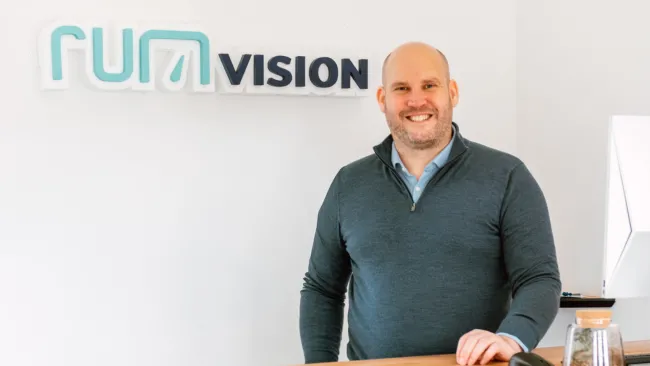
Roderik is the one thinking three steps ahead, turning technical possibilities into business models. He’s our co-founder and oversees business development, business administration, partnerships, and marketing strategy, but you probably won’t see him on stage or in your inbox. Next to RUMvision, he’s been running his own marketing company since 2009.
This interview was conducted by Lars Meijer (Lurz). The other owners of RUMvision have also been interviewed, and articles will be dedicated to them as well, so you can get to know us a little better.
Roderik, you've been running your own marketing consultancy (i4Marketing) for over 15 years. Why start a software company on top of that?
Frustration, basically. I've been advising companies on marketing strategy for years. This means I have gained a lot of knowledge in Google Ads, SEO, and website opportunities. And I kept running into the same problem: websites that were too slow. For instance, I had a client targeting farmers in Australia, and their site just couldn't handle it. People were bouncing before the page even loaded. The Internet in these regions isn’t too stable.
I always thought every website was fast enough. Turns out that's not true. It's mostly about choices in frontend development, hosting, caching, and third-party scripts. Those four variables primarily determine whether your site is fast. And, still, some companies have no idea. Not every website visitor has an ideal environment with a good device and a stable, fast internet connection. Maybe everybody should start focusing on the fact that most website visitors can have a good experience?
How did RUMvision start?
Erwin, our CTO, came to me with the technical methodology. He said: “With Core Web Vitals, we can build something that actually measures what real users experience.” In this case, we don’t use lab tests or simulations in ideal conditions with the latest phones and the best connections. We use real data.
I looked at that and thought: this can be a business. So we started together with Karlijn, our CEO. All three of us kept our other work. We bootstrapped RUMvision, and funded the business ourselves. There are no investors involved, pushing us to grow faster than we should.
What is the focus for RUMvision in 2026?
Together with the team, we translate what's technically possible into what makes business sense. Personally, I don't write code (no ambitions). I hear what we can build and figure out how it fits into a business model.
In my opinion, the world is ready to step up the game by focusing on measuring and capturing the hard numbers for the 90th percentile (p90) of your visitors. At the moment, most in this industry optimize for the 75th percentile (p75) because that's what Google uses for Core Web Vitals. But why would you settle for 75%? You wouldn't ship a square table with three legs. p90 is where the real wins are. That’s going to be one of our key points for the marketing strategy this year.
You mentioned bootstrapping. What's that been like?
Tight, sometimes. We've had to invest a lot in the new version, so in our backend, our data collection, data storage, and UI, but we've never had external investors telling us what to do. Our profit goes back into the product. In 2026, we have more than 1,500 websites (still) using RUMvision. Something I'm very proud of.
How does 2.0 change the way you work?
The key is efficiency. With RUMvision 2.0, much of what Jordy (Co-owner and Head of Customer Success) and I do manually will be automated. The automated health check (our new module), onboarding, and basic explanations are all being incorporated into the product. Not so we can take on fewer clients, but so we can spend our time on things that actually need a human. RUMvision will move from a SwaS (Software with a Service) to SaaS. Of course, our excellent and fast responding service will be a key part of RUMvision.
What's the hardest part of marketing a tool like RUMvision?
The market doesn't yet know what it requires. Core Web Vitals have only existed since 2020. A lot of people are still stuck, for example, on monitoring their performance using Lighthouse scores because that's what they've used for years.
For example. In some CRO projects, tests are run under perfect conditions, and when performance is poor during a test, they can throw out the results because the visitor experience is not the same; hence, the data is unreliable.
The majority is looking for easy solutions, and they are right!
We're in that phase of the product lifecycle where the early adopters get it, but the majority doesn't. The majority is looking for easy solutions, and they are right! They don't want to understand how it works; they want results. Easy spotting of quick wins with the solutions presented to the right person. That's what our version 2.0 is all about. Also, business metrics are next on our roadmap. We show people what a faster site does to their conversion rate, and, believe me, suddenly, they care. More than 50 trusted research studies by big brands have already shown the benefits of fast, stable, and quick-response websites.
Where do you see RUMvision in two years?
We'll have made the full transition from SwaS to SaaS. The product will be self-explanatory. People won't need us to hold their hands through every dashboard when necessary. We will focus on further integrating AI to help our customers gain insights and solutions using their own real-time data. Just like now, with alerts, but also the solution presented within seconds. And also further developing our consultancy on edge cases and helping third parties gain insights into their performance using our data.
Personally, I'd like to spend less time on execution and more on strategy. Always a pleasure to advise other founders on their companies, as I enjoy building businesses and helping them overcome challenges to pursue their goals, with support from my activities at my other company.
But first, we launch 2.0. That's priority number one right now.