Many B2B wholesalers put off a webshop replatforming because their current site still takes orders. When pages feel slow, the default reflex is to patch what you have: optimize a few images, tweak caching, or disable a heavy script.
Eventually, patching stops working.
When industrial rubber and plastic supplier VR Trade BV teamed up with Dutch agency 3WebApps to evaluate their Magento store, real user data proved that incremental fixes were no longer enough. Instead of pouring more budget into an aging Porto theme and third-party checkout, they rebuilt the storefront on Hyvä Commerce, kept their complex B2B quote workflows intact, and optimized beyond launch day using 90th percentile (P90) field data.
The result: mobile user experience jumped from 30% to 91% at P90, giving both the merchant and the agency a clear connection between site speed and daily business performance.
The rebuild debate: when data proves patching is no longer enough
VR Trade supplies industrial rubber and plastic components for construction and manufacturing, from playground flooring to specialized parts, shipping across Europe within 72 hours from their warehouse in the Netherlands. With sales offices in the Netherlands, France, and Sweden, their webshop is a daily tool for business buyers who need to check technical specs and place orders fast.
Their legacy Magento setup ran on the Porto theme combined with Amasty's One Step Checkout. Over time, accumulated scripts, heavy styling, and B2B catalog logic slowed down the storefront.
In August 2026, their RUMvision field data at the 90th percentile (P90) settled the discussion on whether to patch or rebuild. Focusing on P90 ensures that the slowest 10% of real customer sessions, such as buyers checking specs on a mobile connection on-site, are visible rather than hidden behind averages. The baseline numbers were deep in the red:
- Mobile UX score (P90): 30% overall, with First User Experience (FUX) at 29%. Largest Contentful Paint (LCP) sat at 23%, while First Contentful Paint (FCP) and Time to First Byte (TTFB) scored 0%.
- Desktop UX score (P90): 56% overall (57% FUX), pulled down by a 43% LCP and a 33% Cumulative Layout Shift (CLS).
- Template pain points: On mobile, the homepage scored 26% UX and Product Detail Pages (PDPs) sat at 32%. On desktop, the homepage lagged behind at 48% UX and 34% FUX.
For business buyers trying to find the right rubber component or place a repeat order, the shop was slow and frustrating to use. Rather than spending more budget on temporary fixes for a heavy legacy frontend, the RUMvision data gave VR Trade and 3WebApps the business case to start fresh.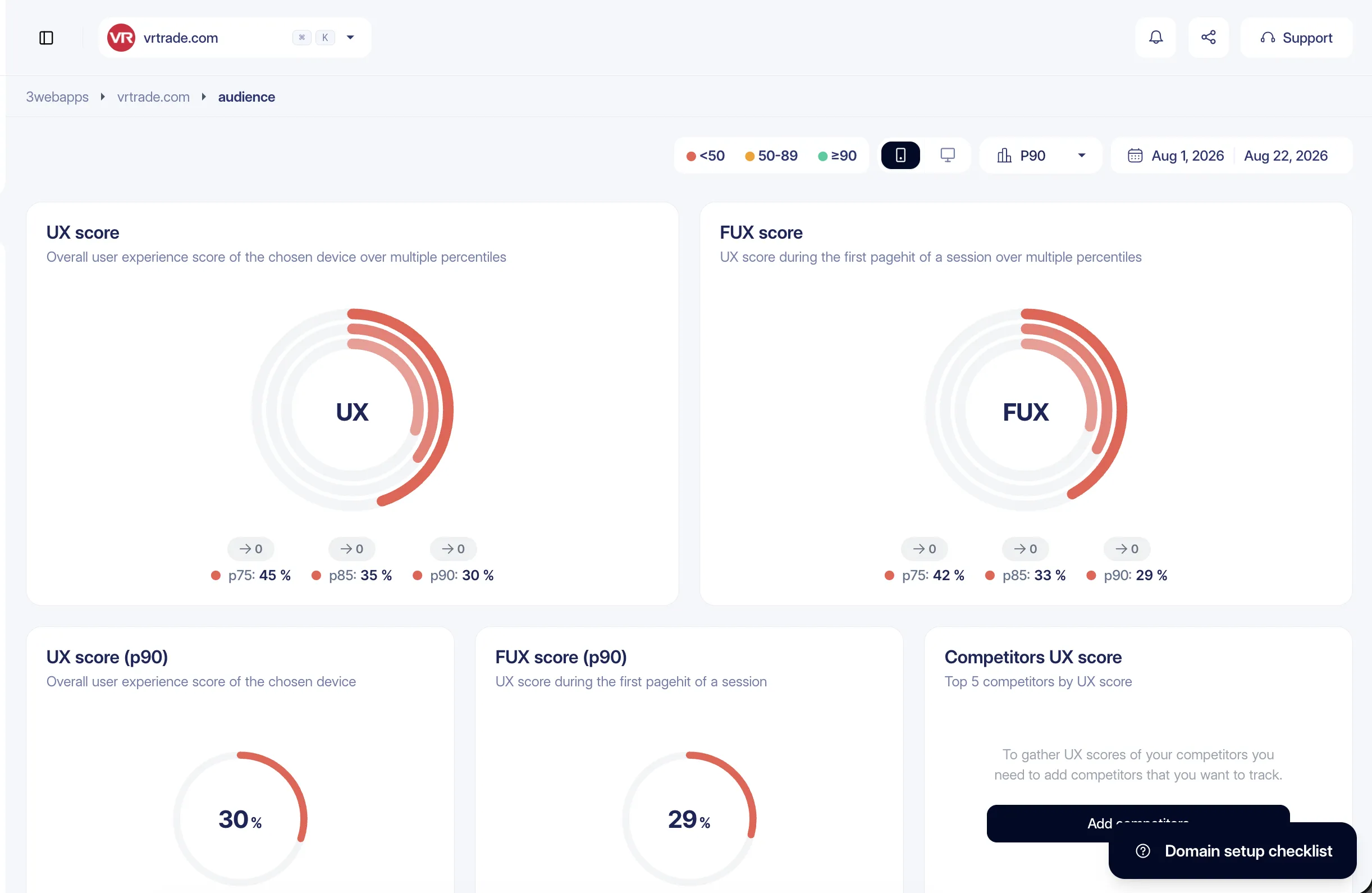
Fast B2B without the compromises on Hyvä Commerce
A common hesitation among B2B merchants is whether a lightweight frontend can handle complex wholesale workflows. 3WebApps migrated VR Trade's webshop to Hyvä Commerce and Hyvä Checkout alongside a refreshed, WCAG-accessible design, proving you do not have to strip out B2B functionality to gain speed:
- Unified checkout architecture: Replacing Amasty One Step Checkout with Hyvä Checkout meant both the storefront and the checkout now run on the same lightweight infrastructure instead of loading conflicting scripts.
- Quote workflows alongside direct ordering: The team migrated Amasty's Request a Quote module into Hyvä Commerce and expanded the buying flow so business customers can choose between requesting a custom quote or checking out directly.
- Custom content control: 3WebApps built custom modules around Hyvä CMS so VR Trade's team can manage and update content pages independently.
As one of 3WebApps' first Hyvä Commerce implementation, weekly alignment meetings between the agency, client, and the Hyvä team kept development moving, and the platform launched on schedule.
Looking past the averages: tuning the slowest 10% after go-live
Many case studies stop at launch day and celebrate green average scores. Yet moving to Hyvä Commerce was the starting point rather than the finish line. Removing Porto and legacy checkout scripts immediately improved responsiveness, while post-launch RUMvision data showed which templates still needed attention to satisfy the slowest 10% of real users.
By iterating step by step across templates and devices, VR Trade and 3WebApps transformed their P90 field performance by November 2026:
| Metric / Template (P90) | Before (Aug 2026) | After (Nov 2026) |
|---|---|---|
| Mobile UX score | 30% | 91% |
| Mobile FUX score | 29% | 90% |
| Mobile LCP | 23% | 92% |
| Mobile CLS | 0% | 100% |
| Mobile INP | 93% | 97% |
| Desktop UX score | 56% | 87% (95% at P75) |
| Desktop FUX score | 57% | 89% (95% at P75) |
| Desktop LCP | 43% | 84% |
| Desktop CLS | 33% | 100% |
Breaking those numbers down by page template shows where the biggest gains happened for their B2B catalog:
- Homepage: Mobile UX jumped from 26% to 98% (96% FUX), while desktop UX climbed from 48% to 91%.
- Product Listing Pages (PLP): Mobile UX rose from 51% to 98%, and desktop went from 61% to 89%.
- Product Detail Pages (PDP): Mobile UX improved from 32% to 90%, while desktop climbed from 66% to 89%.
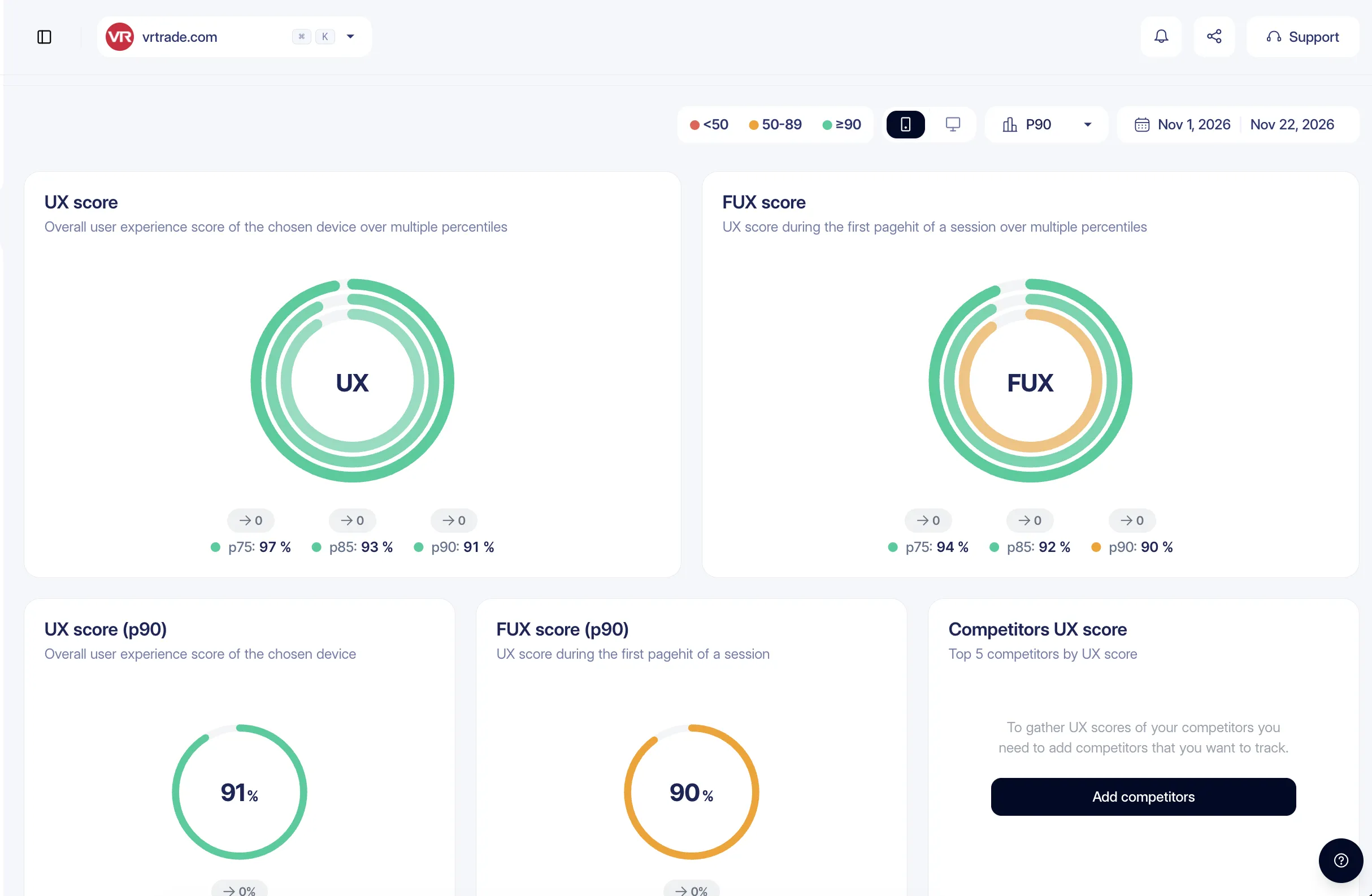
Mobile scores in RUMvision after the rebuild (nov. 2026)
Looking at P90 also keeps the optimization roadmap honest. Interaction and visual stability metrics (INP and CLS) now sit between 97% and 100% across devices. At the same time, P90 TTFB (32% on desktop, 50% on mobile) and desktop search pages (71% UX) highlight backend caching and search query tuning as clear priorities for the next sprint.
From red Core Web Vitals to revenue insights via MCP
A faster storefront is only part of the picture when leadership wants to see how technical investments relate to daily orders. To connect performance directly to business outcomes, 3WebApps integrated RUMvision data via our Model Context Protocol (MCP) into their own reporting environment, ShopReport.
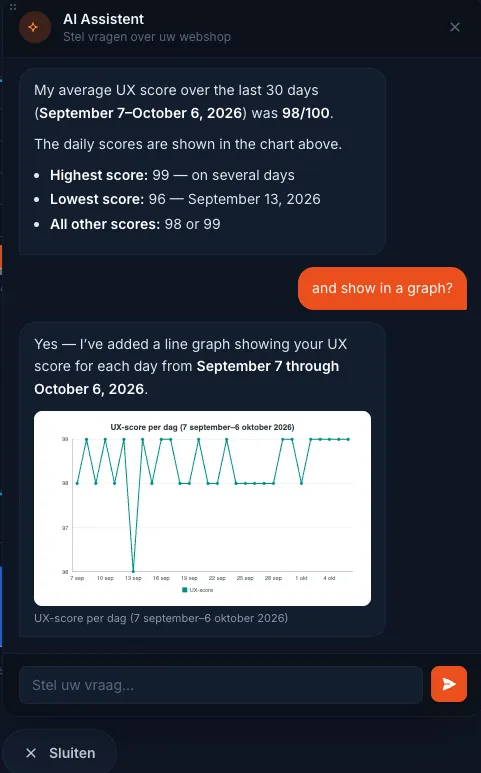
By plotting daily UX scores directly next to sessions and revenue, and letting stakeholders ask questions through an AI chat interface, 3WebApps links user experience to commercial results. When an AI summary flags a dip in UX score, developers can jump straight back into RUMvision's template and percentile views to find the technical cause.
Practical takeaways for B2B migrations
- Use field data to settle the patch-vs-rebuild debate: When P90 scores across core templates are deeply red, investing in a modern stack like Hyvä Commerce pays off faster than patching legacy frontend debt.
- Keep B2B workflows and checkout on one stack: Moving both the shop and checkout to Hyvä eliminates conflicting scripts while keeping quote requests and custom CMS control intact.
- Optimize beyond P75 and launch day: Reserve post-launch capacity to tune real user edge cases at the 90th percentile, where mobile B2B buyers and large catalog queries feel the biggest difference.
- Bring UX metrics into business reporting: Connecting field data via MCP puts site speed right next to sessions and revenue, making performance visible to everyone on the team.